
Collaborative learning is part of the dynamics of innovative teaching methods. It is no longer based on a top-down model where knowledge is held by an expert, but on a collective construction of skills. Everyone becomes a co-actor in their own learning, in permanent interaction with others.
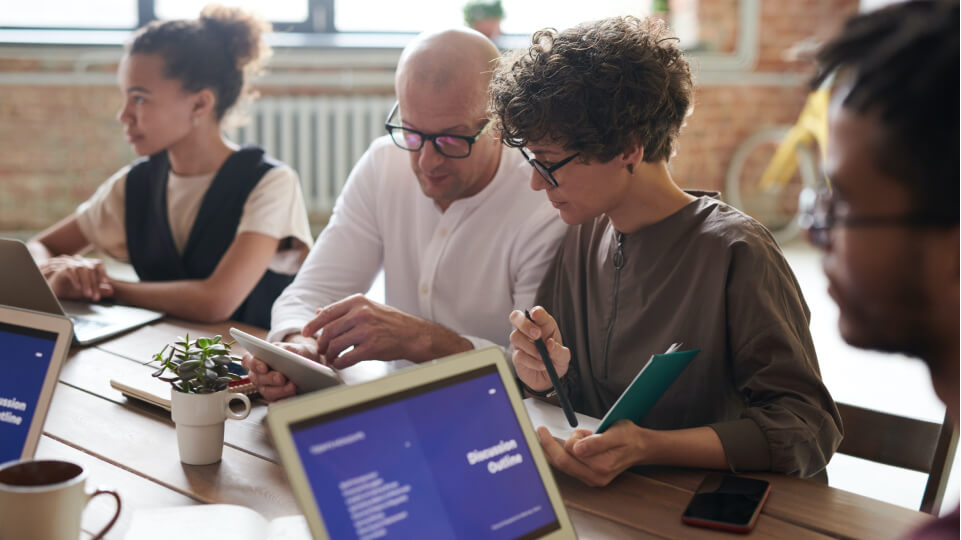
This paradigm shift is all the more relevant in a professional environment where the complexity of tasks and the variety of expertise require constant agility. Brothers and researchers David Johnson & Roger Johnson, major figures in educational psychology in the United States, have also highlighted the fact that cooperative learning environments promote better knowledge retention, increased self-esteem, and greater motivation among participants.
Why are companies focusing on collaborative learning
Addressing skills obsolescence
Faced with the acceleration of technological and organizational changes, companies must constantly update their skills pool. Collaborative learning is therefore establishing itself as an adaptive and effective model, capable of quickly mobilizing internal knowledge while strengthening team cohesion.
Concrete effects on performance
Collaborative learning helps break down barriers between professions, showcase informal, often invisible expertise, and encourage greater employee accountability. It creates a dynamic of horizontal transmission where everyone can take turns sharing and learning. According to a Forbes article on collaborative learning, “Collaborative learning connects high-performing employees with newcomers so they can learn in a way that is unique to the organization.”
Collaborative workshop in business catalyst for collective intelligence
The collaborative workshop embodies collaborative learning in a structured and repeatable form. By bringing together diverse profiles around a common goal, it encourages the emergence of original solutions while strengthening the sense of belonging. In companies, these workshops can be part of strategy, continuous improvement, innovation, or change management approaches. They rely on methodologies such as design thinking or co-development, and can be deployed both in person and remotely, via digital collaborative tools.
How to facilitate effective collaborative work?
Facilitating a collaborative workshop requires real expertise. The facilitator must establish a clear framework, explain roles, and ensure that everyone finds their place in the group. They adopt an active listening posture, reformulate the ideas expressed, and ensure a smooth flow of discussion. Using a variety of techniques su, ch as brainstorming, world caf, and mind mapping helps maintain a constructive group dynamic.
Tools and platforms anchoring collaboration over time.
To sustainably integrate collaboration into training practices, companies can rely on specialized digital platforms. Risp, for example, allows for the deployment of hybrid courses, combining traditional training, collaborative workshops, and discussion spaces. Employees can co-create content, share feedback, and interact in real time or asynchronously. Artificial intelligence completes the experience, offering summaries, tailored content, and personalized follow-up.
Challenges, conditions for success, and limits of collaboration
A culture to be brought out
Collaborative learning requires a culture conducive to trust, sharing, and the right to make mistakes. Without these foundations, the system’s risk remains superficial. It’s up to the organization to create an environment where knowledge flows freely, without judgment, and where everyone can learn from each other.
Essential supervision
The role of management is crucial in avoiding abuses: monopolizing the conversation, reproducing bias, or a lack of engagement. A structured and supportive framework can support diverse profiles and ensure the fairness of contributions. Far from being a simple trend, collaborative learning is emerging as a demanding yet powerful training method to meet the challenges of business transformation.